As the deployment of wind and solar energy increases, precise real-time forecasting for these variable renewable energy (VRE) sources becomes essential for utilities, energy dealers, and grid balancing authorities with substantial renewable energy capacity. Projections of the fundamental variables, namely wind speed and global horizontal irradiance (GHI), along with the consequent power output, are required across various timeframes, from minutes and hours in advance (to ensure grid stability and resource allocation) to day-ahead (for optimizing unit commitment) and extending to several days ahead (for maintenance scheduling). Such forecasts necessitate the integration of diverse techniques, each possessing distinct advantages, into a unified forecasting system to produce forecasts over this spectrum of scales. Optimal systems integrate physical and dynamical forecasting techniques with statistical learning and Artificial Intelligence (AI) methodologies to enhance predictive capabilities.
The KREPS system blends observations, atmospheric physics and dynamics, and artificial intelligence (AI) methods (Fig. 1) to predict the best estimate of wind and solar power output. AI-based forecasting components are colored orange and gold. The KREPS forecasting system is grounded in data, both real time and historical, to build and validate the systems. Surface observations (colored green in Fig. 1) come from meteorological towers, use-specific measurements at the wind and PV plants, and actual power production by the individual wind turbines and PV blocks.
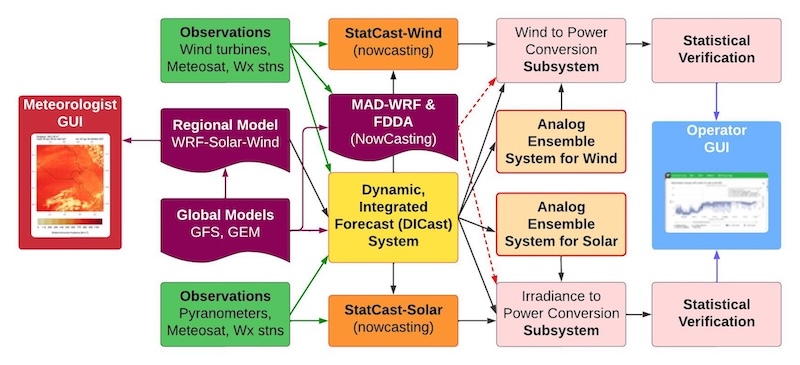
The physics-based models (colored burgundy in Fig. 1) leverage Numerical Weather Prediction (NWP), both at the global and the local scale. These NWP models integrate the fluid equations of motion forward in time from initial conditions based on observations and boundary conditions from global models. Important physics processes (such as radiative transfer, land surface processes, surface layer, atmospheric boundary layer, cloud physics, convective processes, and more) are parameterized in these models.
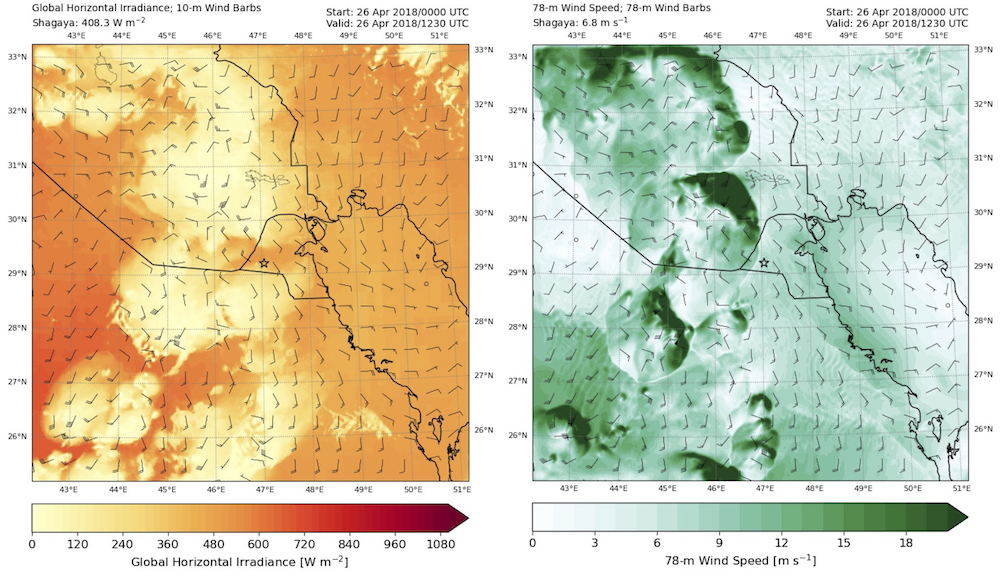
In addition to using global models from several national forecasting centers, KREPS includes customized NWP forecasts tuned to optimize prediction of Kuwait’s wind speed and solar irradiance using the Weather Research and Forecasting (WRF-Solar-Wind) model. Fig. 2 illustrates wind speed and irradiance predictions for a sample day, highlighting the impact at Shagaya.
The AI-based components of the modeling system, highlighted in orange and gold in Fig. 1, are described in more detail herein. The centerpiece of the system (dark orange) is NCAR’s Dynamic Integrated foreCasting (DICast®) system, which blends information from the NWP models and tunes the predictions to historical observations. Two nowcasting systems, StatCast-Wind and StatCast-Solar, focus on improved forecasts for the shortest ranges, the Nowcast, which we define as the first six hours of the forecast. Beyond that, DICast blends in the NWP components. Because grid operators require information on power rather than the meteorological variables, wind speed and global horizontal irradiance (GHI), the results are converted to power using AI methods for both the wind and solar forecasts. The end users also request probabilistic information, provided by an Analog Ensemble (AnEn) for both wind and solar. We find that the AnEn is capable of doing both functions (power conversion and probabilistic prediction) in a single step. Statistical verification systems are built into the full system, as are displays for both wind and solar irradiance and their resulting power output. Example plots from the display are shown in Figure 3.
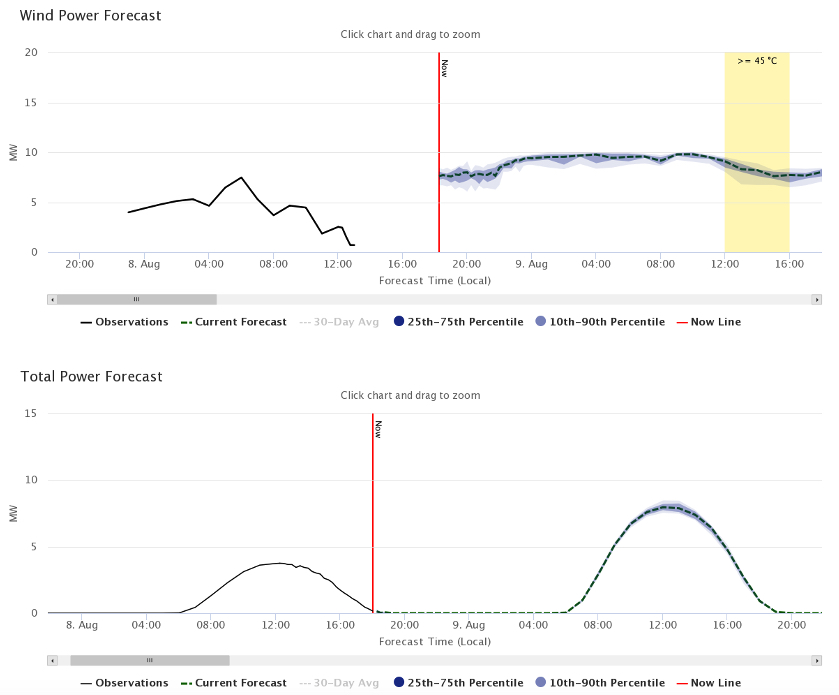
KREPS has demonstrated that improvements occur when AI is used both to correct and supplement the physically-based forecasting systems. Total error is decreased when AI methods are employed. It also allows smooth forecast blending across scales, where the nowcast improves upon DICast, blends and transitions into a smooth forecast. The probabilistic forecasts are displayed to the end user to provide actionable decision support.